ATTRACTIONS OF THE VISIT
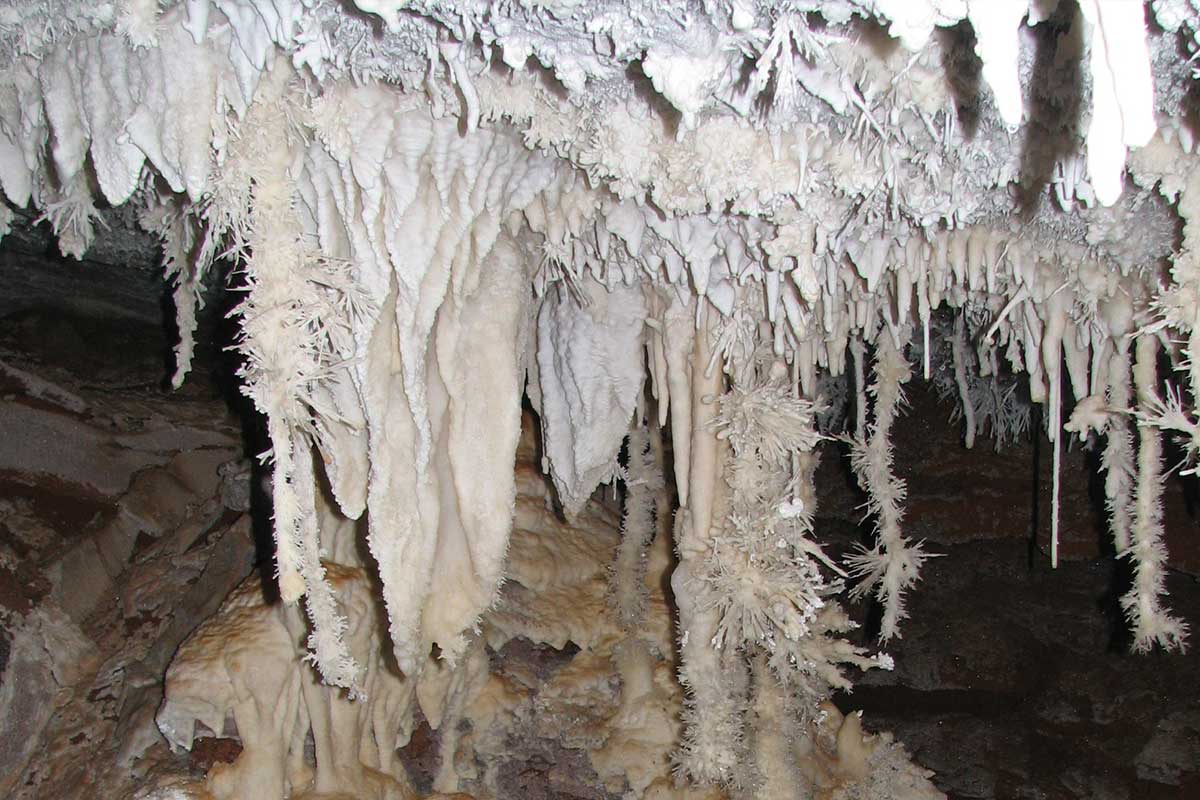
The cave is a cavity with an impressive and very fragile universe of speleothems (formations or structures that can be found inside a cave such as stalactites or stalagmites), with extremely fine and delicate shapes of great beauty, and light colours that contrast with the reddish and dark tones of the slate and clay that surround them, making the beauty of the karst formations stand out even more. The fragility of the formations and the risk of their alteration and destruction by indiscriminate visits led to their declaration as a protected natural area in 1997 as a Natural Monument.
The great variety of speleothems and their mineralogy (aragonite, dolomite, huntite, magnesite, hydromagnesite and sepiolite) is what makes the Castañar cave a unique karst cavity in the world. Both in the visit to the cave and in the Interpretation Centre you can appreciate this variety of speleothems that we describe below:
– Tailings: these are formations, generally of calcite, with large mantles that reach the ground in a staggered manner and were formed in areas where the flow of water was great.
– Flags or curtains: they are formed in areas where water flowed out through joints or small fractures, they hang from the walls like veils and are essentially of calcite.
– Rods: these are vertical forms with a tubular morphology that hang from the ceiling and have a central channel through which the water drips. They are made of aragonite or calcite.
– Stalactites: similar but larger than the rods. They are made of calcite or aragonite.
– Stalagmites: they grow from the ground, whenever there is a drip from a stalactite. Their composition is calcitic and/or aragonitic.
– Columns: they are formed by the union of stalactites and stalagmites.
– Fibrous forms: these are the most characteristic speleothems in the Castañar cave. They are acicular crystals of aragonite, although locally they may have been transformed into calcite. They develop from a central point, forming very delicate fibrous-radial aggregates called “aragonite flowers”, which appear in the geopark logo.
– Moon-milk: this is a type of speleothem that usually develops on top of other previous speleothems, in their outermost zone. It is a dull white globular deposit that may have a high intercrystalline water content. The fundamental minerals that form it in this cave are dolomite and magnesite.